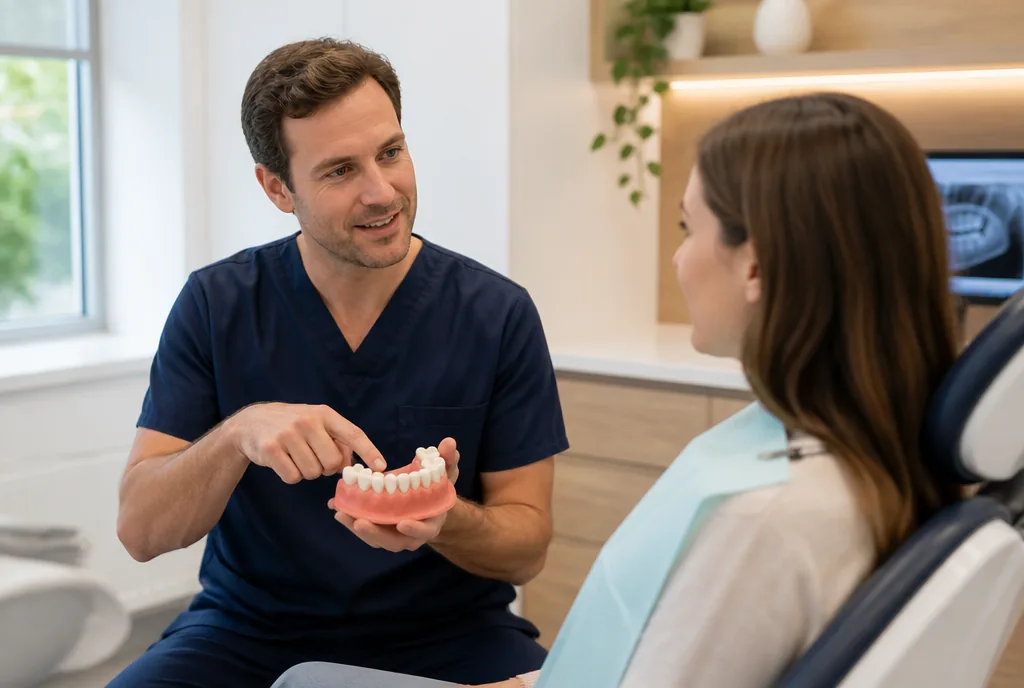
Tooth decay is one of those conditions almost everyone has heard of, yet few people could explain how it actually works, why it happens or what modern tooth decay treatment involves. That knowledge gap matters, because decay is progressive: the longer it is misunderstood and ignored, the more complex and expensive it becomes to fix. In this guide, the team at Footscray Dental Studio breaks down the causes, the five stages of decay and the full range of treatment methods, from simple fluoride applications to root canal therapy.
Tooth Decay Made Easy to Understand
Tooth decay is the breakdown of the hard structures of a tooth, primarily the enamel on the outside and the dentine beneath it. It is caused mainly by acids that form when the bacteria living in your mouth metabolise the sugars and carbohydrates in your diet. The mechanism unfolds in a recognisable sequence: plaque forms on the teeth, the plaque bacteria generate acid, the acid breaks down the tooth structure, and eventually infection sets in.
It helps to know that tooth decay and cavities are related but not identical. Decay is the ongoing destructive process, while a cavity is the resulting damage, the actual hole left behind. We cover cavities, their symptoms and prevention in a separate guide.
Decay is a very common condition among both children and adults in Australia. The reassuring part is that when it is detected early, usually during a routine check-up, it can be managed very satisfactorily, often without any drilling at all.
As for symptoms, they track the depth of the damage. Early decay is silent. As it advances you may notice sensitivity to hot, cold or sweet foods, discomfort when biting, visible discolouration or pits on the tooth, persistent bad breath, and eventually constant or throbbing pain. Any of these signs is a good reason to book an examination.
Hidden Causes Behind Tooth Decay and Cavities
Decay rarely has a single cause. It is usually the product of several everyday factors working together, some obvious and some surprisingly easy to miss. Understanding them is worthwhile, because every cause on this list is something you can influence.
Rampant Bacterial Activity
Your mouth naturally hosts bacteria, and most of the time they cause no trouble. Problems begin when those bacteria break down the sugars and carbohydrates you eat. Their metabolism produces acids that attack the protective enamel, stripping calcium and phosphate from the tooth in a process called demineralisation. That mineral loss is what initiates decay, and repeated acid attacks are what keep it going.
Consumption of a Sugary Diet
Frequent snacking on sugary foods and drinks, think biscuits, pastries and fruit juices, creates an ideal breeding ground for decay. Interestingly, the problem is not primarily about quantity. It is about frequency. Every sugary snack triggers a fresh acid attack, and frequent snacking leaves the enamel with very little time to remineralise between attacks.
The Oral Health Foundation has warned that high levels of sugar consumption are a massive threat to our oral health, and that dental decay is often the result. Children are particularly vulnerable to tooth caries because of unchecked sugar and chocolate consumption, and Australian research points to a steep surge in childhood decay over the past decade.
Poor Oral Hygiene
This is the single biggest reason people suffer from decay and cavities. Neglecting the basics, regular brushing, flossing and rinsing after meals, gives bacteria free rein to attack the enamel. Food particles stuck between the teeth gradually kick off the decay process, leading to cavities and persistent bad breath. If a lingering odour is one of your symptoms, our article on what causes a tooth decay smell explains why.
Dry Mouth
Saliva is one of your mouth's unsung heroes. It removes stuck food particles, neutralises acids and delivers the minerals enamel needs to repair itself. A persistently dry mouth, whether from inadequate hydration or from certain medications such as antibiotics, removes that natural protection and leaves the teeth far more exposed to acid attack.
Lifestyle and Behavioural Factors
Smoking and vaping both increase susceptibility to cavities. Tobacco particles in the mouth reduce saliva production, which elevates decay risk in the same way dry mouth does. Poor hydration compounds the problem by making it easier for bacteria to attack the enamel throughout the day. Finally, irregular dental visits allow decay to progress quietly and unchecked, which is why so many people only discover a problem once it has become genuinely painful, and by then the simplest treatments are usually off the table.
Understanding Each Stage of Tooth Decay
Decay moves through five recognisable stages, each more serious than the last. Knowing where a tooth sits on this spectrum is what determines the right treatment, which is why your dentist's first job is always careful diagnosis rather than jumping straight to a procedure.
Stage 1: Demineralisation
This is the very first stage of cavity formation. Acids produced by the sugar and bacteria reaction begin dissolving phosphate and calcium out of the enamel. At this point there are typically no obvious symptoms, which is precisely why early decay so often goes unnoticed without a professional examination. The only visible clue may be faint white spots on the tooth surface, and even those are easy to miss in the bathroom mirror.
Stage 2: Enamel Decay
If demineralisation continues unchecked, the enamel's natural ability to repair itself drops dramatically. Small pits or fissures start to form in the surface of the tooth. The decay is still confined to the enamel at this stage, and with professional intervention the damage can still be reversed.
Stage 3: Dentine Decay
The third stage is where symptoms usually arrive. Dentine, the layer beneath the enamel, is softer than enamel and contains tiny tubules that connect directly to the tooth's nerve. Because of those nerve connections, patients begin to feel pain when they have cold drinks or sweet foods, or when they apply biting pressure. As the cavity deepens the risks grow quickly, and prompt expert help becomes important if the tooth is to be treated simply.
Stage 4: Pulp Damage
In the fourth stage, decay reaches the tooth's inner core, which houses the nerves, blood vessels and connective tissues. This causes serious dental disturbance, with inflammation and sudden pain. Hot foods or cold drinks can trigger sharp pain, and many patients find the pain is worst when lying down at night, because the change in position increases pressure inside the inflamed tooth. Sleep becomes difficult, and over-the-counter pain relief tends to offer only partial, temporary comfort.
Stage 5: Abscess Formation
This is the worst stage of tooth decay. The infection spreads from the pulp into the tissues near the tooth root and a pocket of pus forms. The result is intense, persistent pain and swelling in the mouth. An abscess is considered a dental emergency and needs immediate treatment, both to relieve the pain and to stop the infection travelling further.
What Are the Treatment Options for Tooth Decay?
The right treatment method depends entirely on how far the decay has advanced. Suitability always depends on an individual assessment by your dentist, but the options broadly line up with the stages above. If you are wondering what advanced decay actually looks like, our guide on what rotten teeth look like walks through the visual signs stage by stage.
Non-Invasive Treatments (Early Stages)
When decay is caught early and remains confined to the outer enamel, no drilling is needed at all.
- Fluoride treatments: High-fluoride toothpastes strengthen the enamel and stop decay progressing, while professionally applied fluoride varnish or gel can actively help reverse early damage by putting minerals back into the weakened surface.
- A healthy oral routine: Consistent brushing and flossing removes stuck food particles and prevents new plaque forming, giving the enamel the breathing space it needs to remineralise between meals.
A regular check-up and clean is what makes this stage possible, because early decay produces no symptoms you would notice on your own.
Minimally Invasive Restorations (Moderate Decay)
Once a cavity has formed, a small amount of the damaged tooth needs to be removed and restored.
- Dental fillings: The dentist removes the decayed portion, cleans the cavity and places a restorative material. A filling rebuilds the tooth structure, restores normal function and prevents further decay. Material options include composite resin, glass ionomer and amalgam, and your dentist will recommend the best fit for the tooth and its position in the mouth.
The word "surgery" can sound alarming, but a filling is genuinely minor: only the small damaged portion of the tooth is removed, and the appointment is typically over quickly, with our team focused on keeping you comfortable throughout.
Moderate to Severe Cases
At more advanced decay levels a simple filling is no longer sufficient, and stronger restorations come into play.
- Inlays or onlays: These are custom devices crafted in a dental laboratory from an impression of your tooth, then bonded or affixed in place to replace the decayed portion. Because they are made to measure from strong materials, they generally exhibit greater durability than a standard filling.
- Crowns: A crown is a tooth-shaped cap placed over a heavily decayed, structurally compromised tooth. It covers and protects what remains of the natural tooth and restores its normal functions, eating, speaking and smiling included.
Advanced and Deep Decay
Deep decay is often marked by inflammation in the mouth, pockets of pus and sharp, persistent pain. Cases like these require advanced dental treatment under expert supervision.
- Root canal treatment: The dentist removes the infected pulp from inside the tooth, then cleans, disinfects and seals the canals. Root canal therapy allows a badly decayed tooth to be saved rather than removed, and a crown is often placed afterwards to protect and strengthen the treated tooth.
- Pulp therapy for children: For children with advanced decay in a tooth, dentists may recommend a pulpotomy or pulpectomy, which are child-appropriate versions of pulp treatment designed to manage infection while protecting the developing mouth.
Extreme Cases
When decay has gone untreated for a long time, it disrupts the internal structure of the tooth so severely that the tooth is compromised both structurally and compositionally. At that point, no restoration can reliably hold, and keeping the tooth would put its neighbours and the surrounding gum and bone at risk.
- Tooth extraction: In these cases, dentists may recommend removing the decayed tooth to prevent the infection spreading. Anaesthesia is applied before any dental instruments are used, so comfort is prioritised throughout.
- Replacement options: After an extraction, the missing tooth can be replaced to restore both function and appearance. A dental implant is a surgical component that replaces the tooth root and provides a stable foundation for a crown, while dentures are removable false teeth that replace one or more missing teeth. Your dentist can discuss which pathway suits your situation.
How to Reduce the Risk of Tooth Decay
Tooth decay and cavities are largely preventable, and a handful of wise habits can save you thousands of dollars in complex treatment costs down the track.
Maintain your oral hygiene. Brush your teeth twice a day with a soft-bristle brush, floss once daily to remove particles stuck between the teeth, and use a pea-sized amount of fluoride toothpaste. Fluoride helps remineralise the teeth and stops decay before it starts. None of this takes more than a few minutes a day, yet it is the foundation everything else rests on.
Watch your diet and keep up dental visits. Practise moderation with snacking, and cut back on starchy foods such as white bread, pasta, noodles, patties and pizza, along with soft drinks, to reduce the number of acid attacks on your teeth. Then visit your dentist every six months. Regular visits mean decay is detected early, and the treatment can be matched precisely to its severity rather than escalating to something major.
For families in Footscray, Seddon, Yarraville and the surrounding suburbs, that six-monthly rhythm is the single most cost-effective dental decision you can make. Two short preventive appointments a year consistently work out far cheaper, and far more comfortable, than one emergency visit for an abscessed tooth.
Final Words
Left untreated, tooth decay and cavities only lead to further complications, more pain, deeper infection and costlier treatment. The stages never move backwards on their own. If you are noticing any of the signs described above, especially here in Footscray or elsewhere in Melbourne's inner west, do not wait for the pain to make the decision for you. Seek expert assistance early, while your options are still simple.
Footscray Dental Studio on Barkly St offers comprehensive care across the full spectrum of decay, from preventive check-ups and cleans through to fillings, crowns and root canal therapy, along with cosmetic treatments to finish the job beautifully, all under one roof. Our team will assess exactly which stage your tooth has reached, explain your options honestly and recommend the treatment that deals with the problem precisely, clearly and comfortably. Because every mouth is different, suitability and results always depend on an individual assessment.